
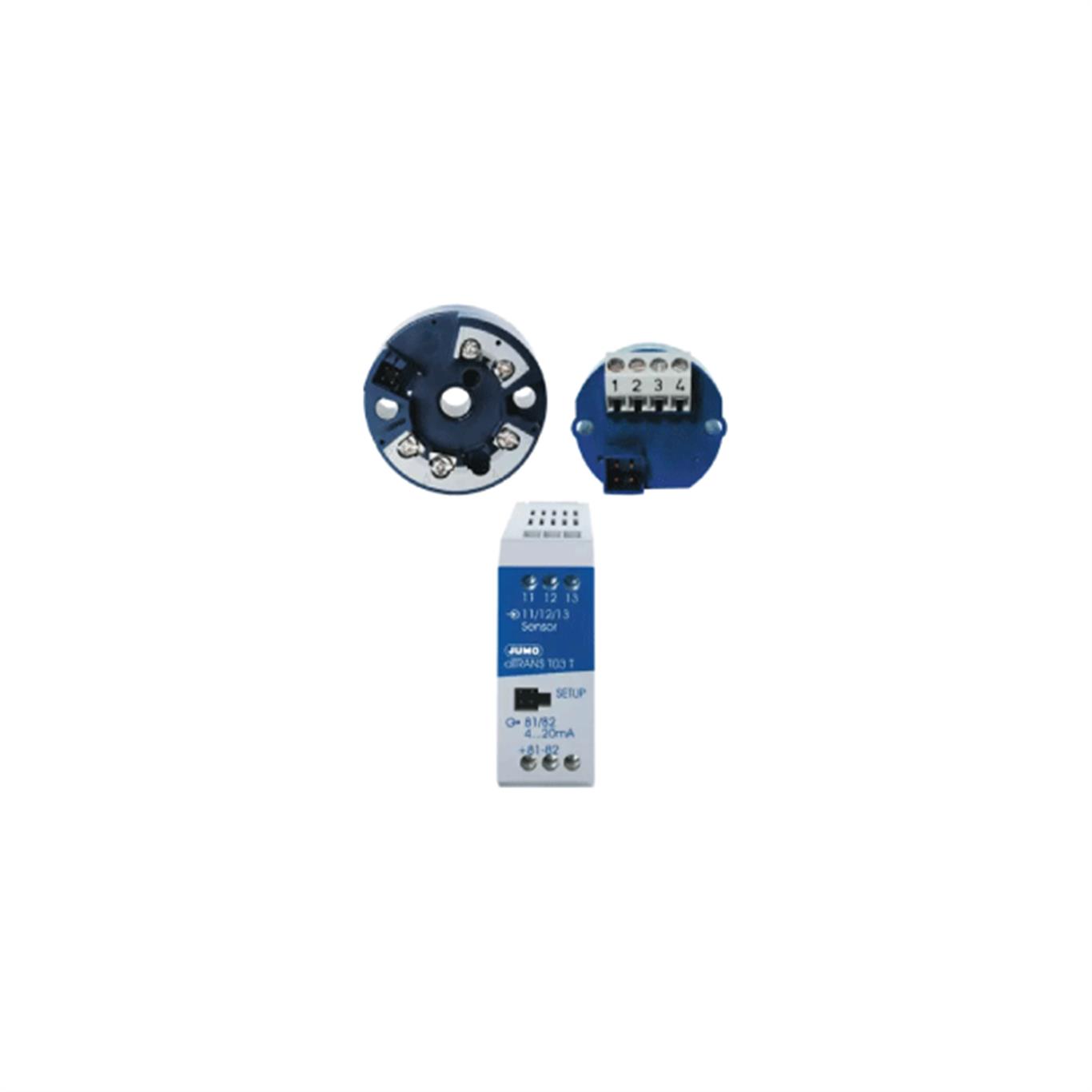
JUMO dTRANS T03
Two-wire or three-wire transmitter
The transmitters intended for industrial applications acquire the temperature with two-wire or three-wire connection. The continuous analog signal path allows for extremely quick output reaction times in the event of a temperature change (analog permanent measurement instead of digital sampling rate).
 |
 |
 |
|
Measuring circuit
monitoring NAMUR NE 43 |
B head, J head, or
DIN-rail mounting |
Configuration
via setup program |
GENERAL TECHNICAL DATA |
| RTD temperature probe input | Pt100, two-wire/three-wire circuit |
| Special features | Analog signal path, can be digitally adjusted/configured |
| NAMUR compliant | NE21 |
| Special features | Analog signal path, can be digitally adjusted |
| Calibration accuracy | ± 0.2 % |
| Configuration | Via PC interface |
| Installation | In terminal head type B/type J or on mounting rail/DIN rail 35 × 7.5 mm |
| Voltage supply | DC 15 to 35 V (two-wire/three-wire transmitter) |
| Output | 4 to 20 mA, 0 to 10 V |
| Ambient temperature | -25 to +70 °C |
| Ambient temperature | -40 to +85 °C |
| Output | 4 to 20 mA, 0 to 10 V |
| Voltage supply | DC 7.5 to 30 V, DC 15 to 30 V (BU) |
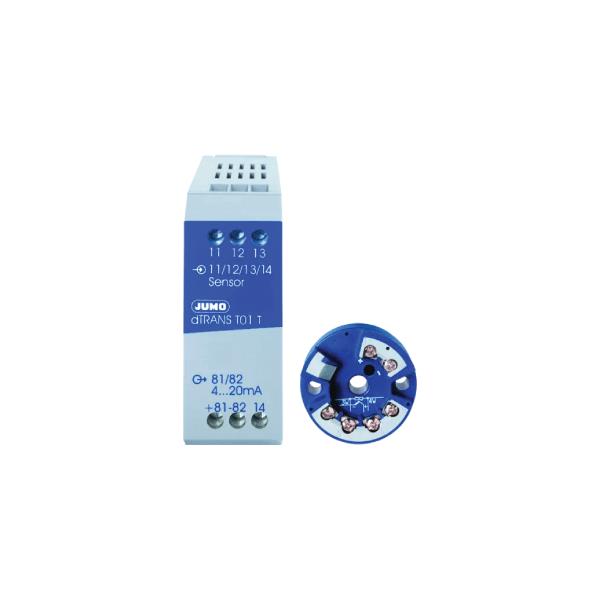
Two-wire transmitter
The two-wire transmitter acquires the temperature through an RTD temperature probe or a thermocouple. For RTD temperature probes, the probe can be connected in a two-wire circuit, three-wire circuit, or four-wire circuit. The dTRANS T01 Ex is designed for mounting in a potentially explosive area.
 |
 |
|
|
Galvanically isolated
input and output |
HART® interface
|
Configuration with
setup program |
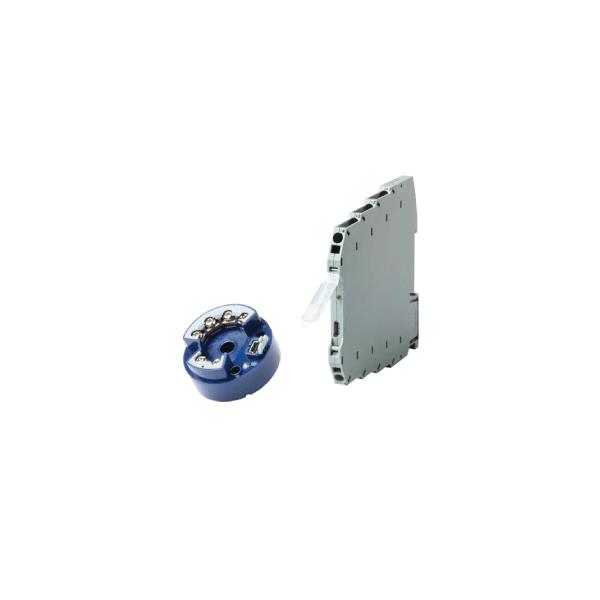
Programmable transmitter in two-wire technology
The transmitters acquire sensor signals from RTD temperature probes, thermocouples, resistance transmitters, or resistors/potentiometers in two-wire, three-wire, or four-wire circuits.
 |
 |
 |
|
Configuration via USB cable
|
Customer-specific linearization
|
Control LED (red/green)
|
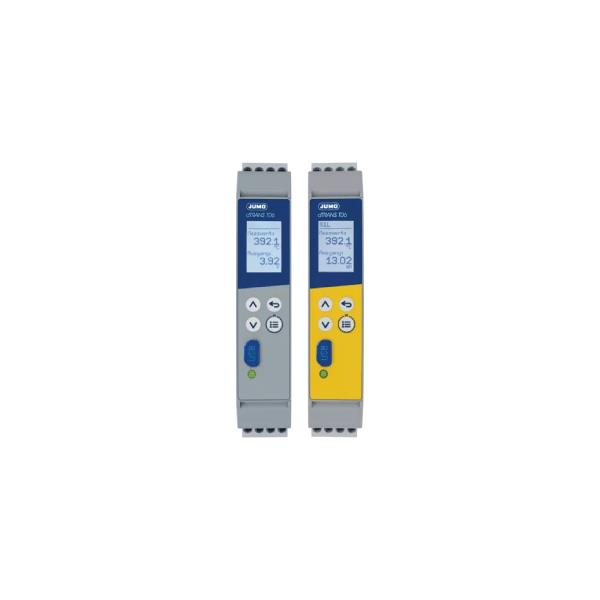
Multifunctional four-wire transmitter in mounting rail case
The transmitter acquires the temperature through an RTD temperature probe or a thermocouple (double thermocouple). The transmitter can also acquire standard signals. Connection takes place through an RTD temperature probe with two-wire, three-wire, or four-wire connection.
|
 |
 |
|
SIL 2/SIL 3
according to DIN EN 61508 |
High galvanic
signal separation |
Universal input
|